
Welcome to our new Website! If you experience problems logging in, please contact us by email at support@south-bay-bio.com or by phone at (415) 935-3226 immediately for assistance!
Catalog number: SBB-PP0101-C025 SKU: 0101 Size: 25 ug
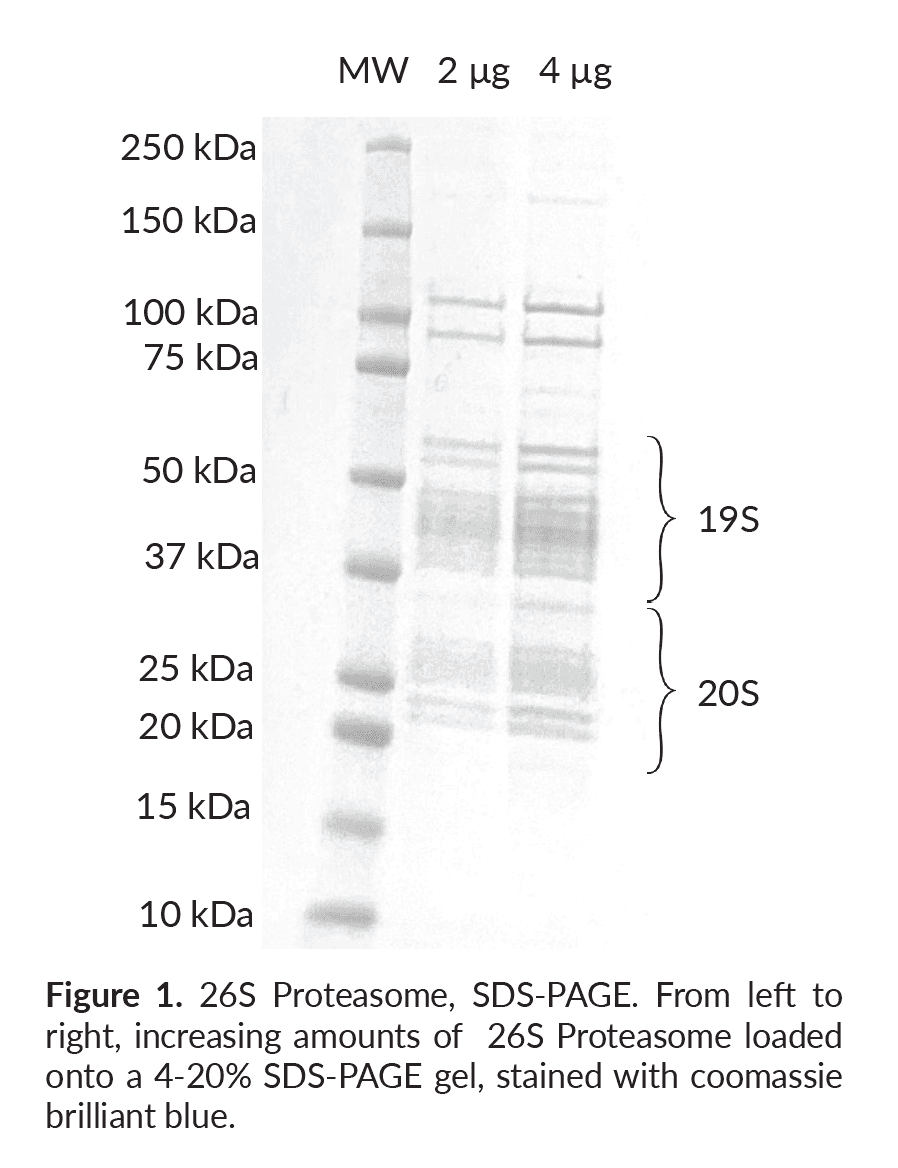
The 26S Proteasome is the major nonlysosomal protease in eukaryotic cells and is responsible for the degradation of ubiquitinated substrates and misfolded proteins. It is composed of two subcomplexes: the 20S Proteasome core particle and the 19S Proteasome regulatory particle. The 20S Proteasome facilitates proteolytic cleavage of protein substrates and is composed of 28 subunits arranged into four stacked rings(1,2). The outer rings of the 20S Proteasome are composed of seven related but nonidentical, noncatalytic subunits, alpha17, that form a gate and restrict substrate access. The inner rings of the 20S Proteasome are composed of seven related but nonidentical subunits, beta 1-7. Beta 1, 2, and 5 have proteyolytic activity. The 19S Proteasome caps one or both ends of the core particle and regulates substrate access to the catalytic core in an ATPdependent manner by modulating 20S Proteasome conformation(3,5). The 19S Proteasome consists of a base subcomplex and a lid subcomplex. The base subcomplex is composed of six AAA+family members, scaffolding proteins, and regulatory proteins involved in Ubiquitin recognition(2,6). The 19S Proteasome lid subcomplex contains eight subunits plus one deubiquitinating enzyme, Rpn11. Small molecules that inhibit the activity of the 26S Proteasome are used to study the function of shortlived intracellular proteins and for the clinical treatment of certain forms of cancer (7). This highly purified 26S Proteasome preparation can be used in vitro for the degradation of peptide substrates and polyubiquitinated proteins.
$285.00
Catalog number: SBB-PP0101-C025 SKU: 0101 Size: 25 ug
The 26S Proteasome is the major nonlysosomal protease in eukaryotic cells and is responsible for the degradation of ubiquitinated substrates and misfolded proteins. It is composed of two subcomplexes: the 20S Proteasome core particle and the 19S Proteasome regulatory particle. The 20S Proteasome facilitates proteolytic cleavage of protein substrates and is composed of 28 subunits arranged into four stacked rings. The outer rings of the 20S Proteasome are composed of seven related but nonidentical, noncatalytic subunits, alpha17, that form a gate and restrict substrate access. The inner rings of the 20S Proteasome are composed of seven related but nonidentical subunits, beta 1-7.
Quantity
Total
$285.00
Free Same-day Shipping on Domestic Orders over $750
| Quantity: | 25 μg |
|---|---|
| Molecular Weight: | >2100 kDa |
| Purity: | >95% by SDS-PAGE |
| Storage Buffer: | 50 mM HEPES pH 7.5, 20 mM NaCl, 2 mM Mg-ATP, 10% Glycerol |
| Storage | Store at -80˚C. Avoid multiple freeze thaw cycles. |
Certificate of Analysis
Open Certificate in New TabCitations and References
1) Kim, H.M. et al. (2011), “Structure characterization of the 26S proteasome”. Biochim. Biophys. Acta 1809:67. 2) Xie, Y. (2010), “Structure, assembly and homeostatic regulation of the 26S proteasome”. J. Mol. Cell Biol. 2:308. 3) Adams, G.M. et al. (1998) “Formation of proteasome-PA700 complexes directly correlates with activation of peptidase activity”. Biochemistry 37:12927. 4) ChuPing, M. et al. (1994) “ATP Binding by Proteasomal ATPases Regulates Cellular Assembly and Substrate-induced Functions of the 26 S Proteasome”. J. Biol. Chem. 269:3539. 5) Kohler, A. et al. (2001) “The axial channel of the proteasome core particle is gated by the Rpt2 ATPase and controls both substrate entry and product release”. Mol. Cell 7:1143.