
Welcome to our new Website! If you experience problems logging in, please contact us by email at support@south-bay-bio.com or by phone at (415) 935-3226 immediately for assistance!
Catalog number: SBB-UP0077, 25 μg
The array of cellular processes initiated and regulated by ubiquitin has been partially explained by the structural diversity of differently linked ubiquitin chains. In a ubiquitin chain, ubiquitin moieties can be conjugated through one of their lysine residues (K6, K11, K27, K29, K33, K48 and K63) or the N-terminal methionine residue (M1), offering countless possibilities to assemble a specific polymer. Ubiquitin molecules can also be modified by other post-translational modifications, including acetylation and phosphorylation, adding another layer of ubiquitin signal regulation and diversification. K29 linked polyubiquitination has been shown to be an inhibitor of Wnt signaling, which plays an important role in embryogenesis, and its deregulation has been shown to play a role in tumorigenesis. This K29 linked di-ubiquitin was recombinantly expressed in E. coli, enzymatically conjugated, and purified via liquid chromatography.
$125.00
Catalog number: SBB-UP0077, 25 μg
This K29 linked di-ubiquitin was recombinantly expressed in E. coli, enzymatically conjugated, and purified via liquid chromatography.
Quantity
Total
$125.00
Free Same-day Shipping on Domestic Orders over $750
| Quantity: | 25 μg |
|---|---|
| Molecular Weight: | 17 kDa |
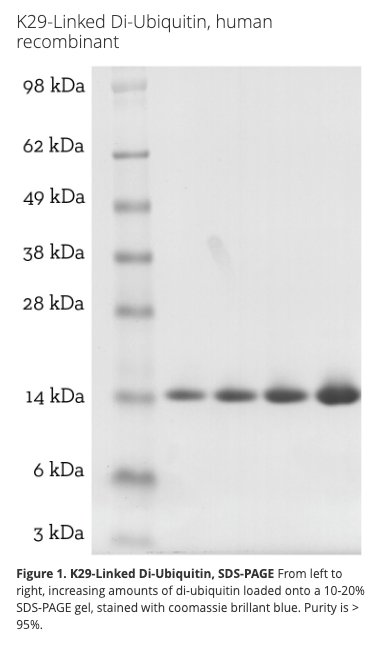
| Purity: | >95% by SDS-PAGE |
| Storage Buffer: | 50 mM HEPES pH 7.5 |
| Storage | Store at −80°C after product arrival. Avoid multiple freeze / thaws. It is recommended to make multiple aliquots after the first thaw. |
Certificate of Analysis
Open Certificate in New TabCitations and References
1) Dikic, I., Wakatsuki, S., & Walters, K. J. (2009). Ubiquitin-binding domains — from structures to functions. Nature Reviews Molecular Cell Biology, 10(10), 659–671. https://doi.org/10.1038/nrm2767 2) Akutsu, M., Dikic, I., & Bremm, A. (2016). Ubiquitin chain diversity at a glance. Journal of Cell Science, 129(5), 875–880. https://doi.org/10.1242/jcs.183954