
Welcome to our new Website! If you experience problems logging in, please contact us by email at support@south-bay-bio.com or by phone at (415) 935-3226 immediately for assistance!
Catalog number: SBB-UP0066, 25 μg
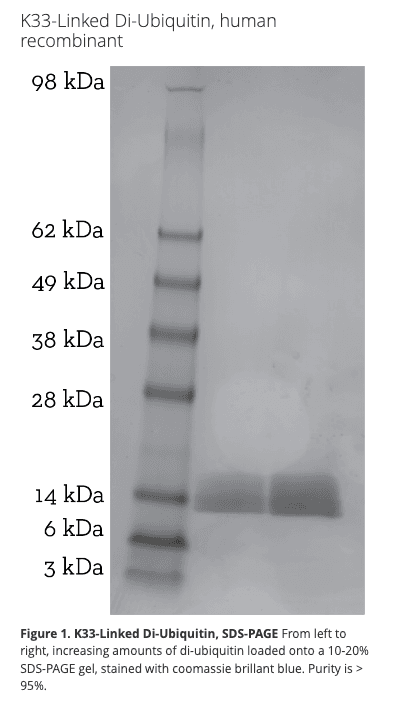
The array of cellular processes initiated and regulated by ubiquitin has been partially explained by the structural diversity of differently linked ubiquitin chains. In a ubiquitin chain, ubiquitin moieties can be conjugated through one of their lysine residues (K6, K11, K27, K29, K33, K48 and K63) or the N-terminal methionine residue (M1), offering countless possibilities to assemble a specific polymer. Ubiquitin molecules can also be modified by other post-translational modifications, including acetylation and phosphorylation, adding another layer of ubiquitin signal regulation and diversification. This K33 linked di-ubiquitin was recombinantly expressed in E. coli, enzymatically conjugated, and purified via liquid chromatography.
$125.00
Catalog number: SBB-UP0066, 25 μg
This K33 linked di-ubiquitin was recombinantly expressed in E. coli, enzymatically conjugated, and purified via liquid chromatography.
Quantity
Total
$125.00
Free Same-day Shipping on Domestic Orders over $750
| Quantity: | — |
|---|---|
| Molecular Weight: | — |
| Purity: | — |
| Storage Buffer: | — |
| Storage | — |
Certificate of Analysis
Open Certificate in New TabCitations and References
1) Dikic, I., Wakatsuki, S., & Walters, K. J. (2009). Ubiquitin-binding domains — from structures to functions. Nature Reviews Molecular Cell Biology, 10(10), 659–671. https://doi.org/10.1038/nrm2767 2) Akutsu, M., Dikic, I., & Bremm, A. (2016). Ubiquitin chain diversity at a glance. Journal of Cell Science, 129(5), 875–880. https://doi.org/10.1242/jcs.183954