
Welcome to our new Website! If you experience problems logging in, please contact us by email at support@south-bay-bio.com or by phone at (415) 935-3226 immediately for assistance!
Quantity: 10 mg
Ubiquitin is a highly conserved protein that plays a major role in the ubiquitination pathway, which is conserved from yeast to mammals. Ubiquitination, the conjugation of ubiquitin to other proteins through a covalent bond between its C-terminal glycine and the ε-amino group of lysine residues or the α-amino group of an N- terminal methionine onto proteins is essential for many cellular process primarily linked to protein degradation. This process involves three steps with specific groups of enzymes in an ATP depended manner, which are activation with ubiquitin-activating enzymes (E1s), conjugation with ubiquitin-conjugating enzymes (E2s), and ligation with ubiquitin ligases (E3s). This Europium Cryptate Ubiquitin is ideal for measuring Ub chain conjugation or deconjugation using TR-FRET measurement. Its TR-FRET pair is Cy5-Ubiquitin. Typical working concentrations range from 250 to 500 nM. However, the best working concentration needs to be empirically determined by the type of application by the end user.
$98.00
Quantity: 10 mg
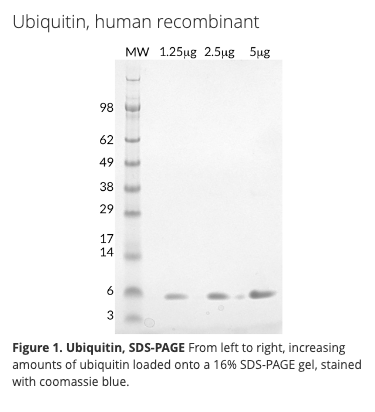
Ubiquitin, human recombinant, is a small (8.5 kDa) regulatory protein found in most eukaryotic tissues. Ubiquitination can signal protein degradation via the proteasome, alter cellular localization, affect activity, and regulate protein interactions. This product consists of full-length human mature ubiquitin (amino acids 1-76), recombinantly expressed in E. coli. Typical working concentrations range from 250 to 750 uM.
Quantity
Total
$98.00
Free Same-day Shipping on Domestic Orders over $750
| Quantity: | 10 mg |
|---|---|
| Molecular Weight: | 8.6 kDa |
| Purity: | >99% by SDS-PAGE |
| Substrate Properties: | Typical working concentrations range from 250 to 750 µM. |
| Storage Buffer: | 50 mM HEPES pH 7.5 |
| Storage | Store at −80°C after product arrival. Avoid multiple freeze / thaws. It is recommended to make multiple aliquots after the first thaw. |
Certificate of Analysis
Open Certificate in New TabCitations and References
1) Hemmilä, Ilkka and Stuart Webb. "Time-Resolved Fluorometry: An Overview Of The Labels And Core Technologies For Drug Screening Applications". N.p., 2017. Print. 2) Komander, David and Michael Rape. "The Ubiquitin Code". Annual Review of Biochemistry 81.1 (2012): 203-229. Web. 9 Mar. 2017. 3) Visser, A. J. W. G. et al. "Time-Resolved FRET Fluorescence Spectroscopy Of Visible Fluorescent Protein Pairs". European Biophysics Journal 39.2 (2009): 241-253. Web. 13 Mar. 2017.